
It is a strange but true historical fact that King Philip II of Macedon met his future queen, Olympias, on the island of Samothrace. There, they were both inducted into the Mystery Cult of the Great Gods—and betrothed, along with a group of Greek nobles, during the initiation rites.
The Greek historian Herodotus wrote of the cult, but as a member, he dared not reveal the sacred rituals.
In The Prince’s Companion, serialized on Royal Road, the story begins with the idea that the mysterious wedding on this sacred island—steeped in secrecy, pain, and transformation—led, nine months later, to the birth of Alexander the Great… and his companion.
In fact, she was still drowsy from the ordeal, still with the gods, half-dreaming as she walked toward the king, who still had a bit of the gods in him himself.
Memory flickered at the edges of her vision.
She was first off the boat. She was expecting a reception fit for a princess. Yet she was grabbed by guards and blindfolded the moment she set foot on the island. Locked in a windowless cell. No food. No water. Only the voices of the women who came to bathe her, to search her body, to ensure she was unspoiled and ready.
She didn’t know if the torture was for the wedding or the initiation.
On the third day—if it was day—the women gave her a cup of bitter wine and told her she was no longer Myrtle. She was nobody.
When she protested, when she dared cry for help, the blows came harder. Over and over: There is no past. You are nothing. You are nobody.
On the third night, or what she thought might be night, a man asked her again who she was. She said she was the daughter of the Epirote king, the ancestor of Achilles, and that the blood of the goddess Thetis ran in her veins. He called her a liar and beat her until she thought she was dead.
But this morning she had no marks on her body. No sign of the struggle. As if it had not happened the way she remembered. As if it was a dream.
Or as if she was transformed into something more perfect.
The man had dragged her to a pit and thrown her down. She fell, tumbling into darkness. She knew she was dead.
Even then, her struggle did not end.
Rough arms lifted her, led her naked into a chamber where the darkness was absolute. When they took her blindfold, it made no difference. She could feel others there—hot breath, waiting.
Among the breaths and hands, she sensed one presence growing stronger, claiming her.
She tried to pull away, but there was no escape.
“Thetis,” she whispered, though her throat was raw.
“Zeus,” he answered.
Others circled them—monsters, nymphs, animals, gods. She felt them watching, felt their hunger. For an instant she thought she would dissolve into terror. But something in her split and reformed.
She became as fierce and hungry as they were. She devoured them instead.
And when she could no longer tell where her body ended and theirs began, the songs rose, and torches flared. She saw him clearly—not a god, but the king. His face was tender and afraid, transformed by awe. She held the power.
The man from the boat was there too, naked, stomping and laughing with the others. They spoke words so ancient they melted time itself.
“The Twins are One. We return to the One. We celebrate the One.”
When dawn came, they were all holding hands, laughing because they had never felt so alive.
She had seen, in all the haze, who she was and who she would be. She would be the mother of a god, a regent, a queen, her name outliving her husband’s. Her enemies would fear her more than her son’s legions. They would call her many things—priestess, witch, mother of Alexander—but they would never call her nobody.
Full text of The Prince’s Companion is available by Hunter Neron on Royal Road.
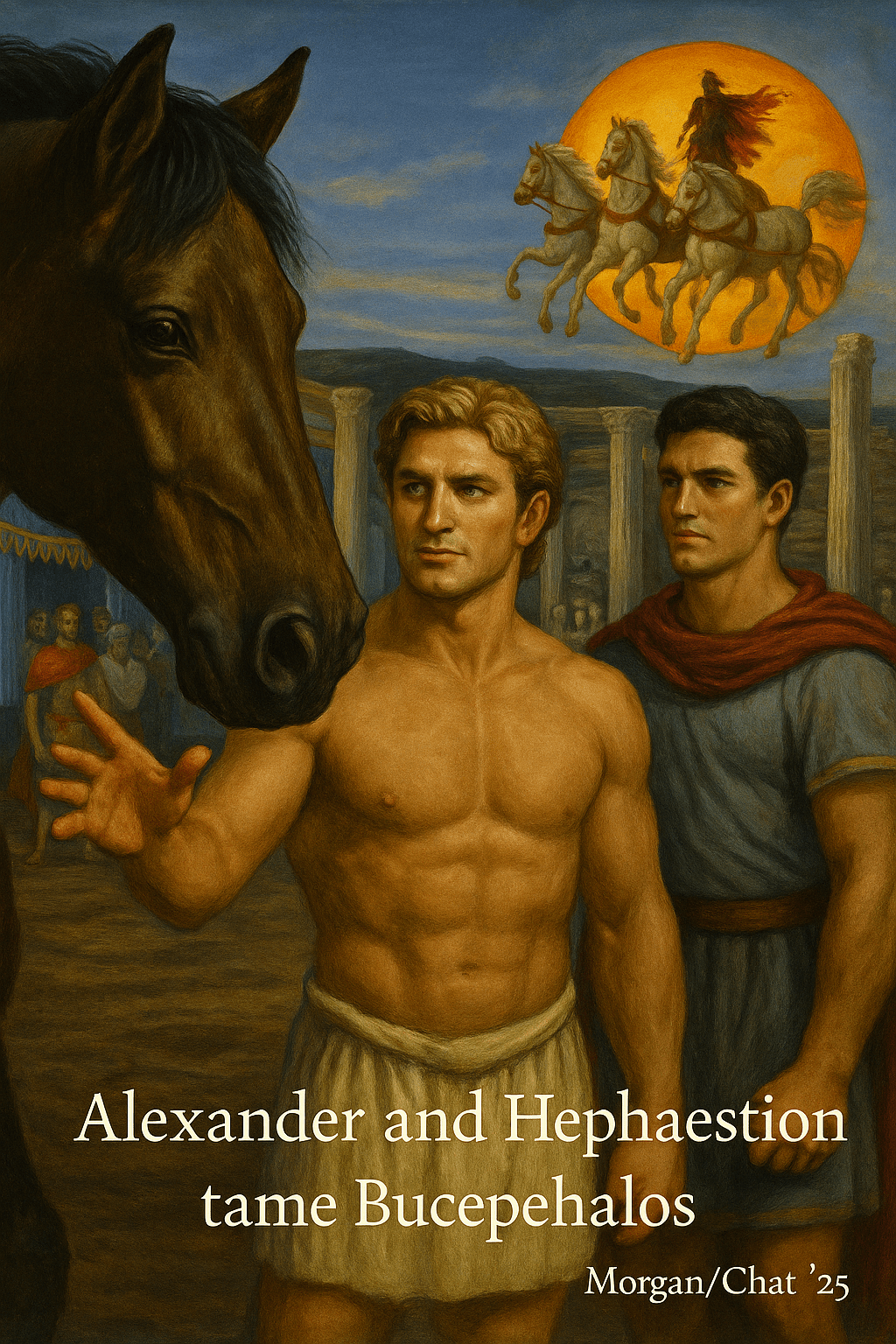
 Twins of Macedon