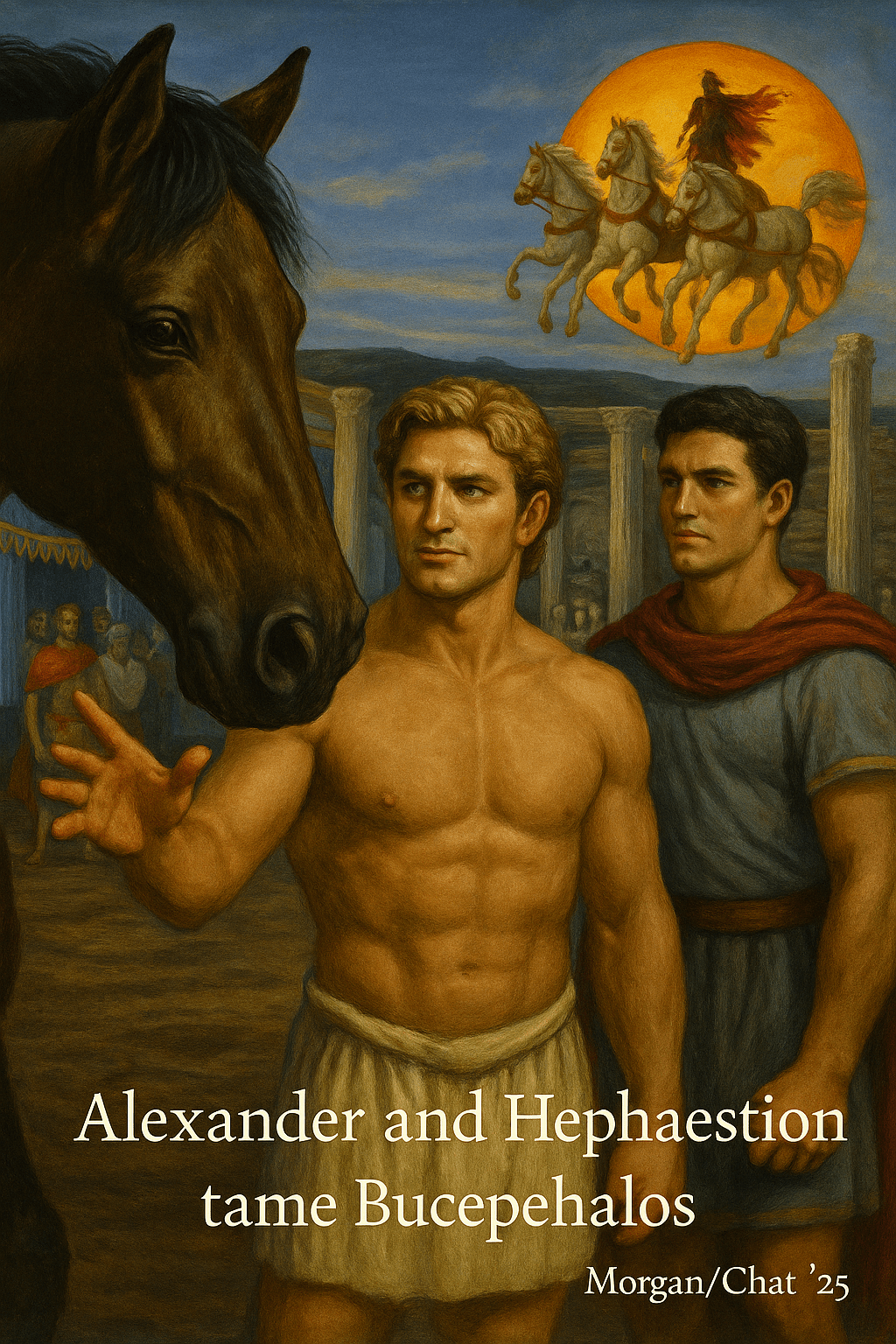
Alexander’s World: August 336 BCE Location: Lamia, en route from Pella to Delphi. This dramatized scene is based on historical accounts of Alexander the Great and the legendary taming of Bucephalos, as recorded by Plutarch and other ancient sources. In our version, Hephaestion stands beside him from the start. From The Prince’s Companion, available on Royal Road, serialized, free.
“What’s wrong?” Alexander asked Hephaestion, recording the incident in the scrolls of his memory.
Hephaestion barely breathed. “That’s the horse.”
His voice was calm, certain—as if he had already seen the outcome.
“That’s the one,” he continued, his excitement getting the best of him. “They say he’s a man-eater, which is absurd. Horses don’t eat flesh. He just won’t let anyone on him who isn’t powerful. Abuse a horse, and it becomes skittish and rebellious. It looks as if it’s scared of its own shadow, but really, it thinks they’re coming up behind it. To hurt it. They hit his back side because he won’t let them up front, and they don’t want to leave marks.”
He paused, his sharp gaze fixed on the stallion. “The stallion senses their cowardice. He’s waiting. One of them is going to get crushed. He sees the hills, too. I suspect the horse led them out—not the other way around.”
Hardly a word all morning, thought Alexander, and now this epic from the boy’s mouth. The prince gazed at the horse, and then back at Hephaestion. The boy’s cloak was one shade lighter than his own indigo. A subtle statement. It marked a family that could afford purple but chose not to wear the royal color out of deference. A gesture of gentility—deliberate and restrained. Yet the cloak also hinted at Hephaestion’s bloodline, which Alexander knew traced back to the first king of Athens.
Hephaestion had made a more questionable fashion choice. At first glance, they might have seemed like a boy’s blunder—gold greaves under the relentless summer sun. A choice ripe for laughter. But no one laughed. Not at someone standing beside the prince. And certainly not at someone wearing armor steeped in history. Those greaves were old, not decorative. Hephaestion had chosen them deliberately. And Alexander wanted to know why.
Besides, the gods had gifted Hephaestion with good looks, the greatest honor they could bestow upon a Greek youth. Alexander turned his gaze back to the magnificent beast in the arena.
“Tame the horse and rule the world,” said Hephaestion. His voice was steady, almost matter-of-fact. “That’s what the Pythian priestess said. Though I can’t imagine how they got it into the Temple of Apollo, considering they can’t even get it into a hippodrome.” His eyes didn’t leave the stallion. “They’re asking a fortune for it, hoping the king will spring for the price. If the king passes, I’ve asked my father to offer half. I can ride that horse, if no one else can.”
“King,” said the horse dealer, stepping forward. “Whosoever can ride this horse will rule the world.”
“They will rule the Underworld sooner,” replied the king. “Whomsoever rides this horse will break their neck.” Philip waved the man away.
Now it was Alexander who stood.
“You’re wrong,” Alexander said. His voice cut the air like a blade. “That horse isn’t afraid. You are.”
Philip smiled. His son was full of himself, indeed. “I don’t need a horse to give me the world, son,” he said, a slight edge in his voice. “I have an army.”
Hephaestion stood and whispered into the prince’s ear.
“Let me have it then,” Alexander said, his voice echoing across the stadium.
The king shifted in his seat, his good eye scanning the arena. The murmurs of the crowd swelled, a fast river tumbling over stones, tongues buzzing on the afternoon breeze. Was this a challenge? No—this was a challenge. He pinched his beard with his fingers. Lucky, he thought, his mother is not here. She would see prophecy in this, twist it to her liking, and make a scene. Olympias had a way of turning events to fit her myths. The gods spoke to her, after all—if you asked her.
He didn’t mind that his wife had strong opinions, but he wished she would keep her mouth shut in public. That was the problem with the Epirote royals. They educated their princesses to rule, just as if they were men. And now, it looked like he couldn’t even control his own wife—just as these bumblers couldn’t control, and had likely ruined, this magnificent beast.
Amyntor leaned in. “Hephaestion knows horses.”
“Having learned the hard way,” Philip replied. Hephaestion was almost killed, critically wounded by being thrown from a horse. Which might happen to his only son if he listened to Olympias’s admonishments in his head. And yet.
Philip exhaled slowly. The boy had something to prove, always throwing himself into the fire. It was maddening. It was… familiar. The king rose, his silhouette stretching long behind him. Lifting his hand, he swept through the air as if clearing space. The murmur vanished—not hushed, but snatched away, as if Boreas himself had bowed in recognition. For an instant, there was nothing. A silence so pure it was not absence, but power itself.
“My son wants me to buy this wild and notorious steed,” he said, his voice ringing out over the theater. “I say, son, if you can ride him, you can have him.”
The crowd erupted into cheers as the horse shook its head and reared, requiring three men to bring it back under control. Alexander strode forward without looking back. And Hephaestion was already at his side.
HUNTER NERON, The Prince’s Companion
 Twins of Macedon
Leave a comment